
Format your document
Formatting text
Ellipsus supports granular text styling as well as global styling, giving you complete control over the look and feel of every part of your document, from individual words, to paragraphs, all the way up to full document styles.
You can format text using the Format panel (the T icon in the right sidebar), or (if enabled) the Desktop formatting bar at the bottom of the screen.
Just select any portion of text and open the Format panel to apply styling. (Granular styling also works in Snippets, keeping your formatting consistent.)
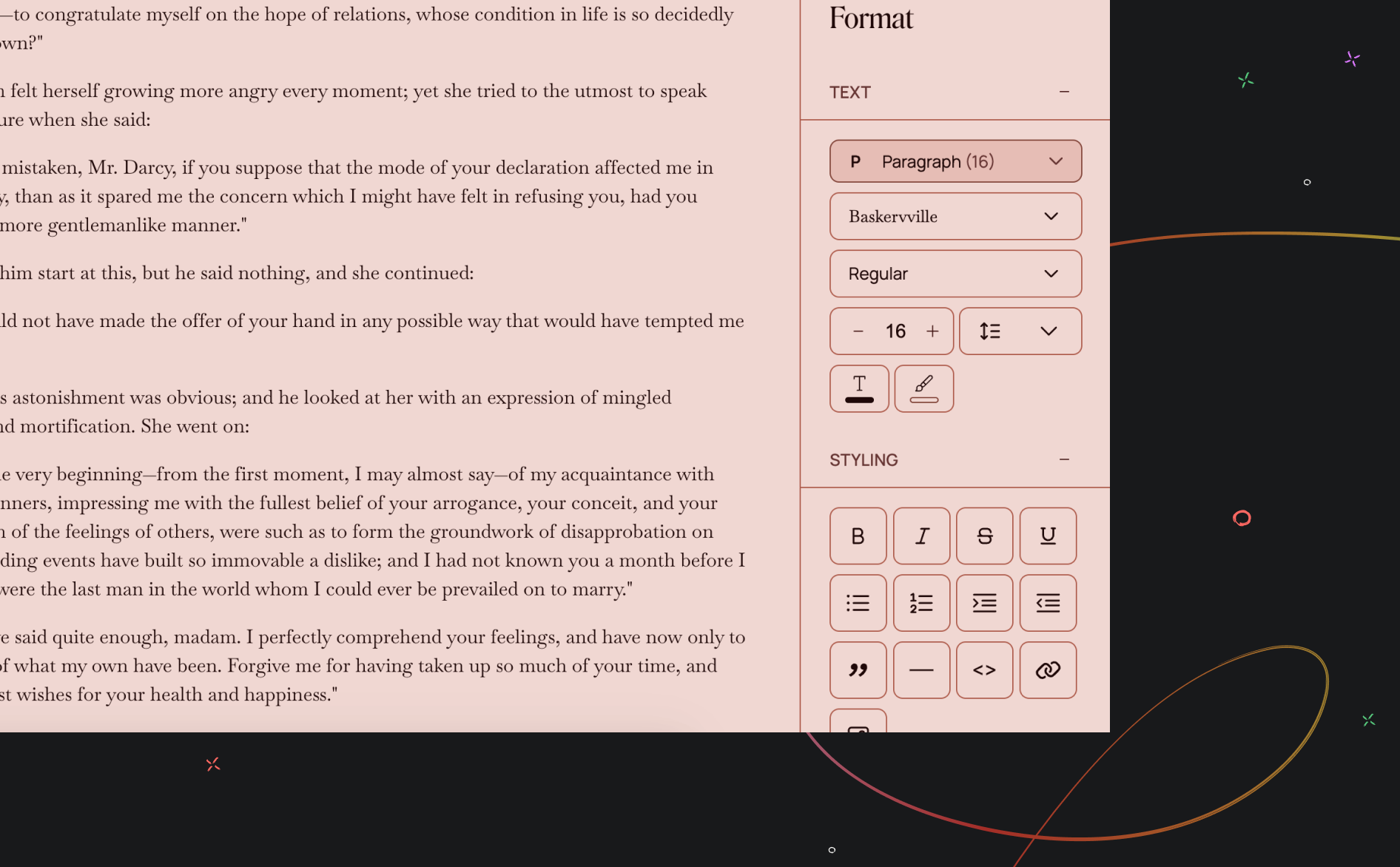
What you can do with the Format panel
When you open the Format panel, you’ll find tools for:
Text:
Apply fonts, sizes and weights
Modify specific style levels (e.g. headings, captions)
Adjust spacing and line height
Add text colors and text highlights
Styling:
Add emphases (bold, italic, underline, etc.)
Create bulleted or numbered lists
Indent/unindent text
Add quotes, dividers, page breaks, hyperlinks, code
Apply clear formatting to remove all applied styling (e.g. bold, italics, underline, color) from selected text, returning it to the default style.
Alignment:
Set your text's alignment (left, center, right, justified)
Set and format pages:
Pages let you switch from a pageless view to a structured print-style layout. You can edit the settings for pages under the Layout section in the panel, and selecting the Pages view. Learn more about pages here.
Save time with shortcuts
Shortcut menu
Editing
Function | Mac shortcut | Windows shortcut |
|---|---|---|
Cut | ⌘ X | Ctrl X |
Copy | ⌘ C | Ctrl C |
Paste | ⌘ V | Ctrl V |
Paste without formatting | Shift ⌘ V | Shift Ctrl V |
Add line break | Shift Enter | Shift Enter |
Undo | ⌘ Z | Ctrl Z |
Redo | Shift ⌘ Z | Shift Ctrl Z |
Indent | ⌘ ] | Ctrl ] |
Unindent | ⌘ [ | Ctrl [ |
Formatting
Function | Mac shortcut | Markdown shortcut | Windows shortcut |
|---|---|---|---|
Bold | ⌘ B | ** | Ctrl B |
Italic | ⌘ I | * | Ctrl I |
Underline | ⌘ U | (no shortcut) | Ctrl U |
Align left | Shift ⌘ L | (no shortcut) | Shift Ctrl L |
Align right | Shift ⌘ R | (no shortcut) | Shift Ctrl R |
Align center | Shift ⌘ E | (no shortcut) | Shift Ctrl E |
Justify | Shift ⌘ J | (no shortcut) | Shift Ctrl J |
Indent | Tab | (no shortcut) | Tab |
Decrease indent | Shift Tab | (no shortcut) | Shift Tab |
Quote | (no shortcut) | > | (no shortcut) |
Inline code | ⌘ E | ' | Ctrl E |
Code block | ⌥ ⌘ C | ''' | Alt Ctrl C |
Divider | (no shortcut) | ---- *** ___ | (no shortcut) |
Text style: Paragraph | ⌥ ⌘ 0 | (no shortcut) | Ctrl Alt 0 |
Text style: Heading 1 | ⌥ ⌘ 1 | # | Ctrl Alt 1 |
Text style: Heading 2 | ⌥ ⌘ 2 | ## | Ctrl Alt 2 |
Text style: Heading 3 | ⌥ ⌘ 3 | ### | Ctrl Alt 3 |
Text style: Heading 4 | ⌥ ⌘ 4 | #### | Ctrl Alt 4 |
Numbered list | Shift ⌘ 7 | 1. | Shift Ctrl 7 |
Bulleted list | Shift ⌘ 8 | - | Shift Ctrl 8 |
Strikethrough | Shift ⌘ X | ~~ | Shift Ctrl X |
Insert link | ⌘ K | (no shortcut) | Ctrl K |
Selection
Function | Mac shortcut | Windows shortcut |
|---|---|---|
Select all | ⌘ A | Ctrl A |
Extend selection one character | Shift → | Shift → Shift ← |
Extend selection one paragraph | Shift ⌥ ↑ | Ctrl Shift ↑ Ctrl Shift ↓ |
Extend selection to beginning of line | Shift ⌘ ← | Shift Home |
Extend selection to end of line | Shift ⌘ → | Shift End |
Extend selection to beginning of document | Shift ⌘ ↑ | Shift Ctrl Home |
Extend selection to end of document | Shift ⌘ ↓ | Shift Ctrl End |
Tools
Function | Mac shortcut | Windows shortcut |
|---|---|---|
Open/close chat | ⌘ / | Ctrl / |
Add comment | Shift ⌘ C | Shift Ctrl C |
Find and replace | ⌘ F | Ctrl F |
Next find result | ⌘ G | Ctrl G |
Previous find result | Shift ⌘ G | Shift Ctrl G |
New draft | ⌥ ⌘ N | Alt Ctrl N |
Rename draft | ⌥ ⌘ R | Alt Ctrl R |
Switch draft forward | ⌥ Tab | Alt ↑ |
Switch draft backward | Shift ⌥ Tab | Alt ↓ |
Draft info | Shift ⌘ I | Shift Ctrl I |
Export draft | Shift ⌘ X | Shift Ctrl X |
Layout
Function | Mac shortcut | Windows shortcut |
|---|---|---|
Browser zoom in | Shift ⌘ + | Shift Ctrl + |
Browser zoom out | Shift ⌘ - | Shift Ctrl - |
Browser zoom reset | Shift ⌘ 0 | Shift Ctrl 0 |
Focus mode | Control ⌥ F | Ctrl Alt F |
Toggle dark/light mode | Control ⌥ D | Ctrl Alt F |
Toggle formatting bar | Control ⌥ B | Ctrl Alt B |
Document zoom in | ⌘ = | Ctrl = |
Document zoom out | ⌘ - | Ctrl - |
Document zoom reset | ⌘ 0 | Ctrl 0 |
Show/hide right panel | ⌘ \ | Ctrl \ |
Show/hide left panel | Shift ⌘ \ | Shift Ctrl \ |
You can also find a full list of keyboard shortcuts in the shortcuts panel—available from within any document/draft by clicking the keyboard icon in the expanded help menu.
Desktop formatting bar
If enabled, you will see a formatting bar at the bottom of your editor when working on a larger screen. (If you’re working on mobile, or if your browser width is very narrow, you won’t see this option.)
You can choose to turn the formatting bar on or off via your editor settings. Learn more about customizing your editor settings here.
Global styling
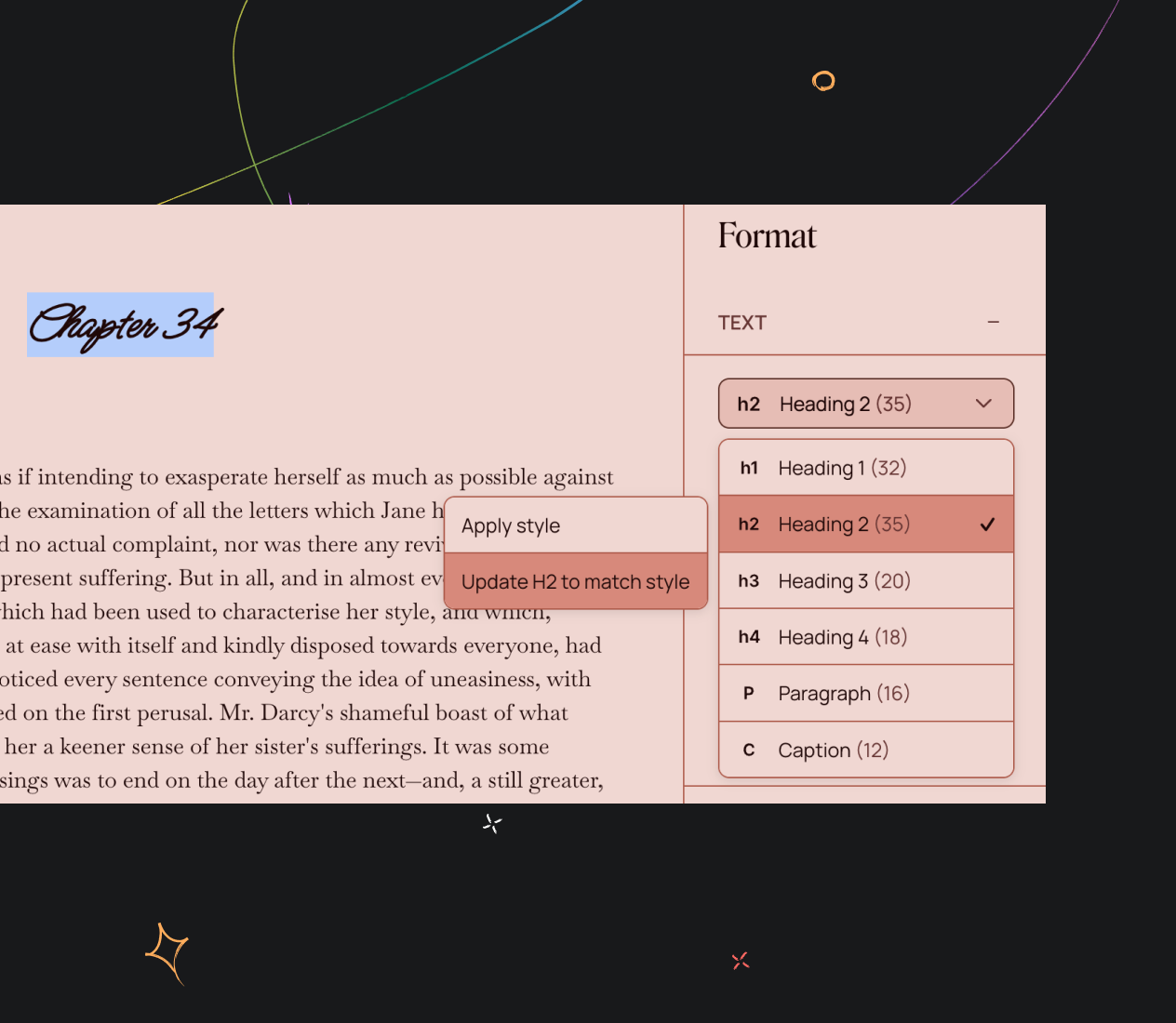
You can choose to format with granular styling by selecting the text you want to format, or global styling. With global styling, you can choose whether a formatting change should apply document-wide.
To change a style everywhere in your document:
Select the text (e.g., Heading 2) you want to update
Apply your formatting changes (font, size, spacing, color, etc.)
Open the Style menu, choose Update (Heading 2) to match style
All paragraphs using that style will immediately update to match the formatting you just applied.
Document appearance and spacing
Ellipsus' spacing settings work like the ones you’ll find in other writing tools. In most cases, the number and type of breaks used in imported documents, copy/pasted text, or exports should cleanly transfer to and from other tools.
There are two main settings that control your document's spacing:
Line height controls the amount of space between lines within the same paragraph.
Paragraph spacing controls the amount of space between one paragraph and the next.
If you want your document to appear single-spaced or double-spaced, adjust the line height setting:
Single-spaced text uses a smaller line height
Double-spaced text uses a larger line height
If your paragraphs look too far apart after changing line height, or you want a visual empty line between paragraphs—instead of pressing "Enter" multiple times to induce paragraph spacing, check your paragraph spacing setting.